How Important Is Social Security to Your Retirement Income?

Yes, it is.
On average, Social Security beneficiaries receive between $500,000-$1,000,000 in benefits.* This usually makes up around 40% of the average American’s retirement income. While the additional 60% is a large chunk to make up on your own, Social Security has some unique advantages.
Depending on how you file could add even more to your income stream. It is a permanent decision that affects the rest of your life, and your spouse’s life as well.
Your benefits have a built-in cost of living adjustment, meaning they increase automatically to match inflation. This helps your spending power stay the same the rest of your life.
Also, your benefits are tax-advantaged. This means you won’t pay taxes on all of your Social Security income. At best, they could be tax-free, or at worst, you’ll pay taxes on a maximum of 85% of your benefits. How much you pay in taxes is determined by how much you make. Here are the details:
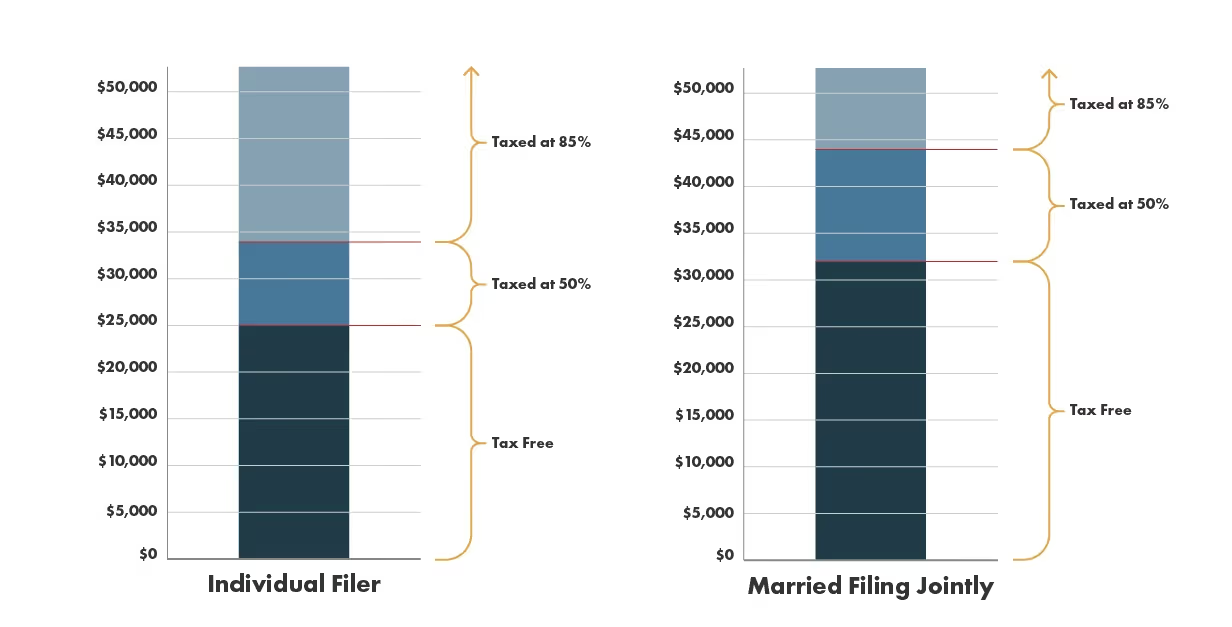
If you are an individual, you’ll pay no taxes on your benefits if your combined income is less than $25,000 and if you are married filing jointly, you’ll pay nothing under $32,000. Above those thresholds, up to 50% of your benefits become taxable — meaning they're added to your taxable income and taxed at your ordinary rate. If your income gets higher than $34,000 for an individual, or $44,000 for married filing jointly, 85% of your benefits will be taxed. †
For example, say you are married filing jointly and have $20,000 of annual Social Security benefits. And after your other taxable income sources (withdrawing money from an IRA or 401k, or earned income from a job) your ‘combined income’ is $70,000. Since you fall into the higher benefits taxation, your taxes would look like this:
- 85% of your Social Security benefits is $17,000.
- In 2026, a married couple filing jointly where both spouses are 65 or older can deduct up to $47,500.
- Remember your combined income is $70,000. Subtract $3,000 of Social Security benefits and $47,500 of deductions from your combined income and you get $19,500. This is your total taxable income for the year.
So, you received $70,000 of total income and only had to pay taxes on $19,500.
In 2026, a married couple filing jointly where both spouses are 65 or older can deduct up to $47,500 before any federal income tax applies. That figure stacks three separate pieces: the $32,200 base standard deduction, the $3,300 additional deduction for age 65 and older, and the temporary $6,000-per-person senior deduction created by the One Big Beautiful Bill Act. A single filer 65 or older can deduct up to $24,150. The senior deduction portion is available for tax years 2025 through 2028 and phases out for incomes above $75,000 for single filers and $150,000 for joint filers.
The thresholds that determine how much of your benefit is taxable, however, have not moved. The $25,000 and $32,000 tiers were set in 1983. The $34,000 and $44,000 tiers were set in 1993. Neither has ever been indexed to inflation. That means every year, as benefits and other retirement income rise with cost-of-living adjustments, more retirees cross into taxable territory. It also means the larger deductions above do nothing to change the provisional income calculation. A retiree can owe zero federal income tax and still have 85 percent of their Social Security benefit counted as taxable income, because those are two separate mechanics.
The final way your benefits are unique is they are backed by the federal government. Few investments receive the strength and stability of the government supporting it. However, you might have heard the Social Security trust fund is running low.
The 2026 Trustees Report projects that the Old-Age and Survivors Insurance trust fund, which pays retirement and survivor benefits, will deplete its reserves in the fourth quarter of 2032. At that point, under current law, incoming payroll tax revenue would be sufficient to pay approximately 78 percent of scheduled benefits. If Congress were to combine the retirement and disability trust funds, the projected depletion date would move to the third quarter of 2034, with roughly 83 percent of scheduled benefits payable. The projection moved one quarter earlier than the prior year's report, driven in part by provisions of the One Big Beautiful Bill Act that reduced beneficiaries' tax liability and, in turn, the income-tax revenue that flows back into the trust fund.
In our next post, you’ll find out why this shouldn’t worry you so much.
* “Social Security and Medicare Lifetime Benefits and Taxes: 2017 ….” 5 Jun. 2018, https://www.urban.org/research/publication/social-security-and-medicare-lifetime-benefits-and-taxes-2017-update. Accessed 30 Aug. 2019.
† Social Security Administration. "Income Taxes and Your Social Security Benefit." ssa.gov/benefits/retirement/planner/taxes.html. Accessed 10 Sept. 2026.
Social Security Administration. "A Summary of the 2026 Annual Reports." ssa.gov/oact/trsum. Accessed 10 Sept. 2026.
Internal Revenue Service. Revenue Procedure 2025-32, "2026 Inflation Adjustments." irs.gov. Accessed 10 Sept. 2026.
Continue Learning
Gain more Insights and empower your financial future with our articles and other resources.